UniConFlow:
Unified Constrained Flow Matching for Certified Motion Planning

A unified generative framework that systematically enforces safety, dynamic consistency, and action feasibility constraints in robot motion planning via prescribed-time guidance.

Generative Model Flow Matching Motion Planning Safety Guarantee Physical Feasibility Kinodynamic Consistency
UniConFlow Teaser 1
UniConFlow Teaser 2
UniConFlow Teaser 3

Overview

Generative models have become powerful tools for robot motion generation, enabling flexible and multimodal trajectory generation. Yet, most existing approaches remain limited in handling multiple types of constraints—such as collision avoidance, actuation limits, and dynamic consistency—often addressing them heuristically or individually.

In this work, we propose UniConFlow, a unified constrained flow matching-based framework that systematically incorporates both equality and inequality constraints. UniConFlow introduces a novel prescribed-time zeroing function (PTZF) that shapes a time-varying guidance field during inference, enabling the generation process to adapt to varying system models and task requirements without retraining.

To further address computational challenges in long-horizon and high-dimensional tasks, we introduce two practical strategies: a violation-segment extraction protocol for precise refinement and a trajectory compression method. Empirical validation on double inverted pendulum, car racing, and manipulation tasks demonstrates that UniConFlow outperforms state-of-the-art generative planners in safety, kinodynamic consistency, and action feasibility.

Comparison with State-of-the-Art Generative Planners

Method Obstacle
Avoidance
Safety
Guarantee
Dynamics
Consistency
Admissible
Action
Adaptive
Guidance
Long-Horizon
Planning
Dataset
Creation
Real-world
Experience
Diffuser
Decision Diffuser
Diffusion-based Policy
ChainedDiffuser
DPCA
DPCC
HDP
CoBL
SafeDiffuser
PCFM
SafeFlow
UniConFlow (Ours)

✅ Explicitly Addressed    ❌ Not Addressed    ⚪ Not Applicable

Pendulum Snapshot 1
Pendulum Snapshot 2
Pendulum Snapshot 3
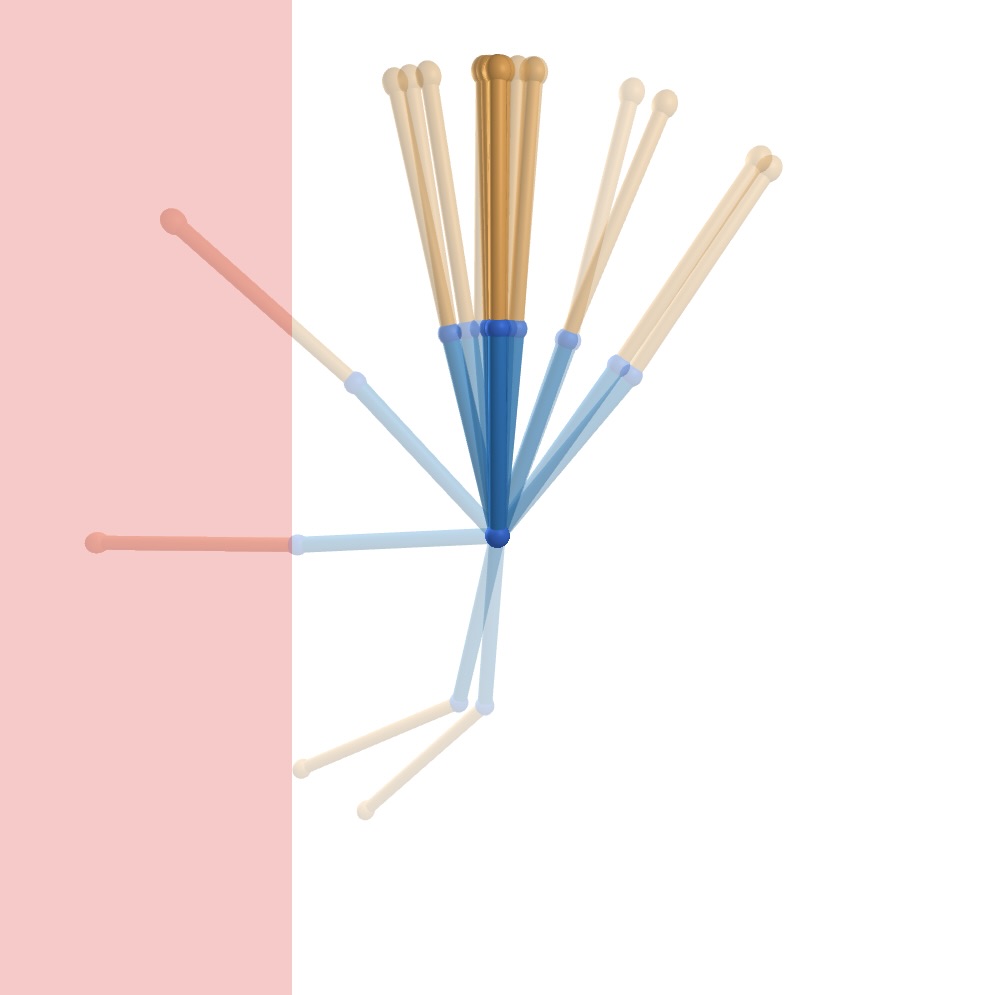
Three snapshots of the pendulum swing-up and stabilization process.

Double Inverted Pendulum

We consider a double inverted pendulum consisting of two rigid links and is actuated by torques at the joints. It operates in the vertical plane under gravity.

The control objective is to swing the pendulum to the upright equilibrium point from any random initial state without collision.

  • Perfect constraint satisfaction: 100% success rate with zero violations.
  • Computational efficiency: Approximately 5 times faster than conventional optimization-based methods while achieving lower trajectory cost.
  • Two-stage inference: PTZF-based guided sampling followed by terminal refinement.

Car Racing on Nürburgring Nordschleife

We employ a nonholonomic vehicle model to simulate the car racing task. The objective is to navigate from a start state to a goal state while adhering to the reference raceline, remaining within the drivable corridor, and avoiding collisions with obstacles.

UniConFlow is the only method to successfully solve both forward and reverse driving tasks with perfect 100% scores across all metrics and zero constraint violations, while all baseline methods fail catastrophically.

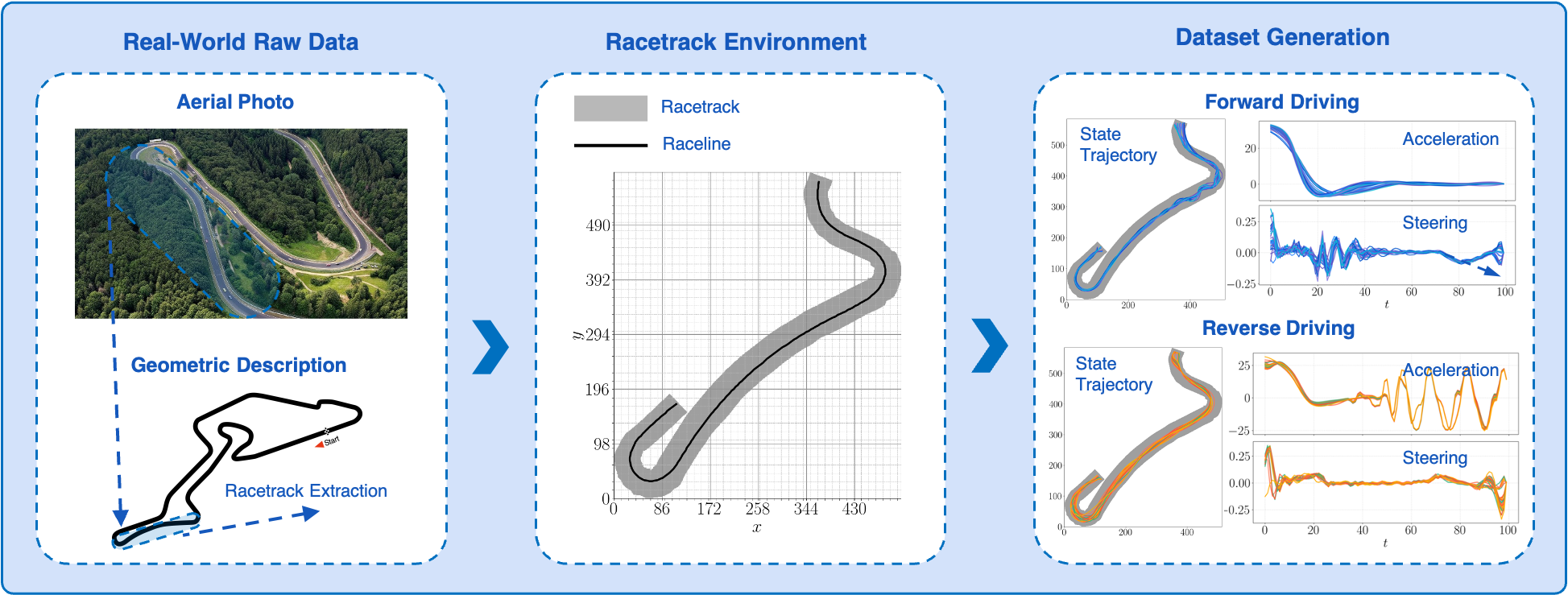
  • Real-to-sim environment creation: Racetrack environment constructed from Nürburgring Nordschleife data through geometric extraction and rasterization.
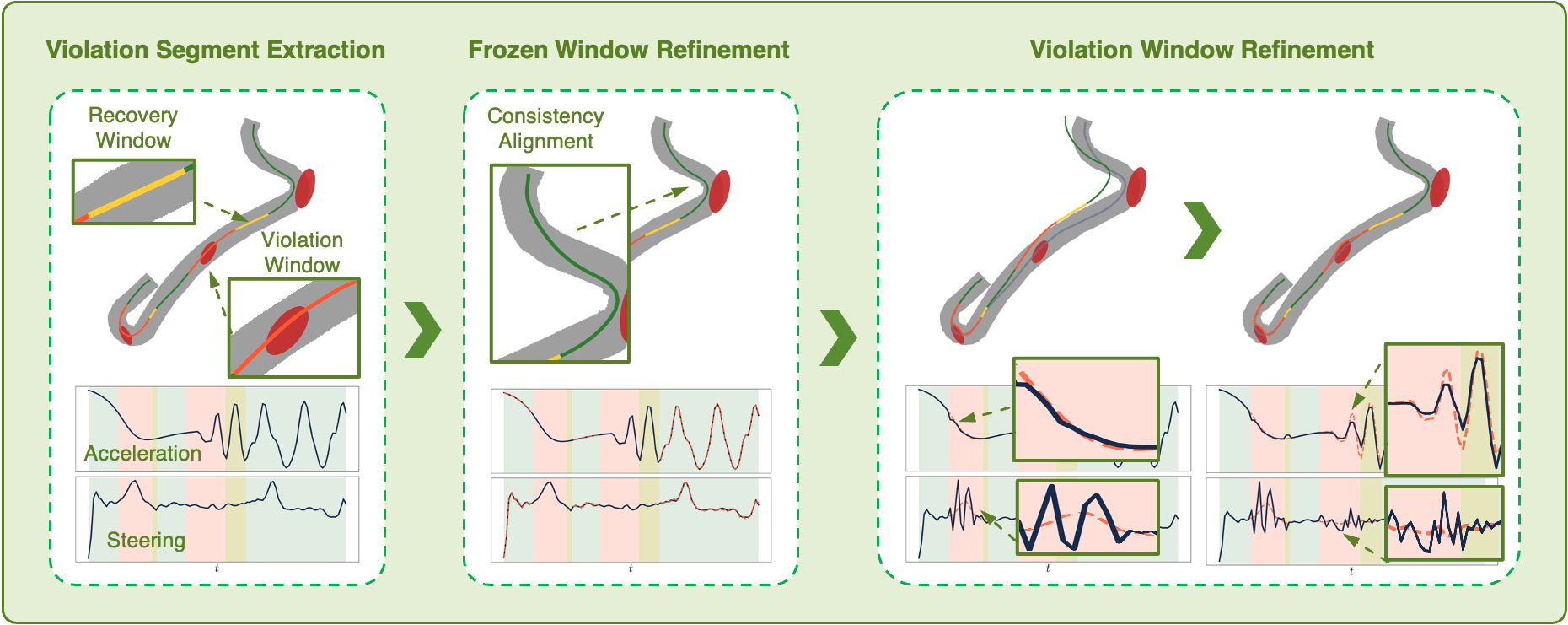
  • Three-step refinement strategy: Violation segment extraction, frozen-window refinement, and violation-window refinement with global certification.
  • Comprehensive validation: Forward and reverse driving experiments validate the method's effectiveness, achieving 100% success rates with zero violations in both scenarios.
Dataset Generation Pipeline
The Dataset Generation Pipeline.
Terminal Refinement Pipeline
The Terminal Refinement Pipeline.
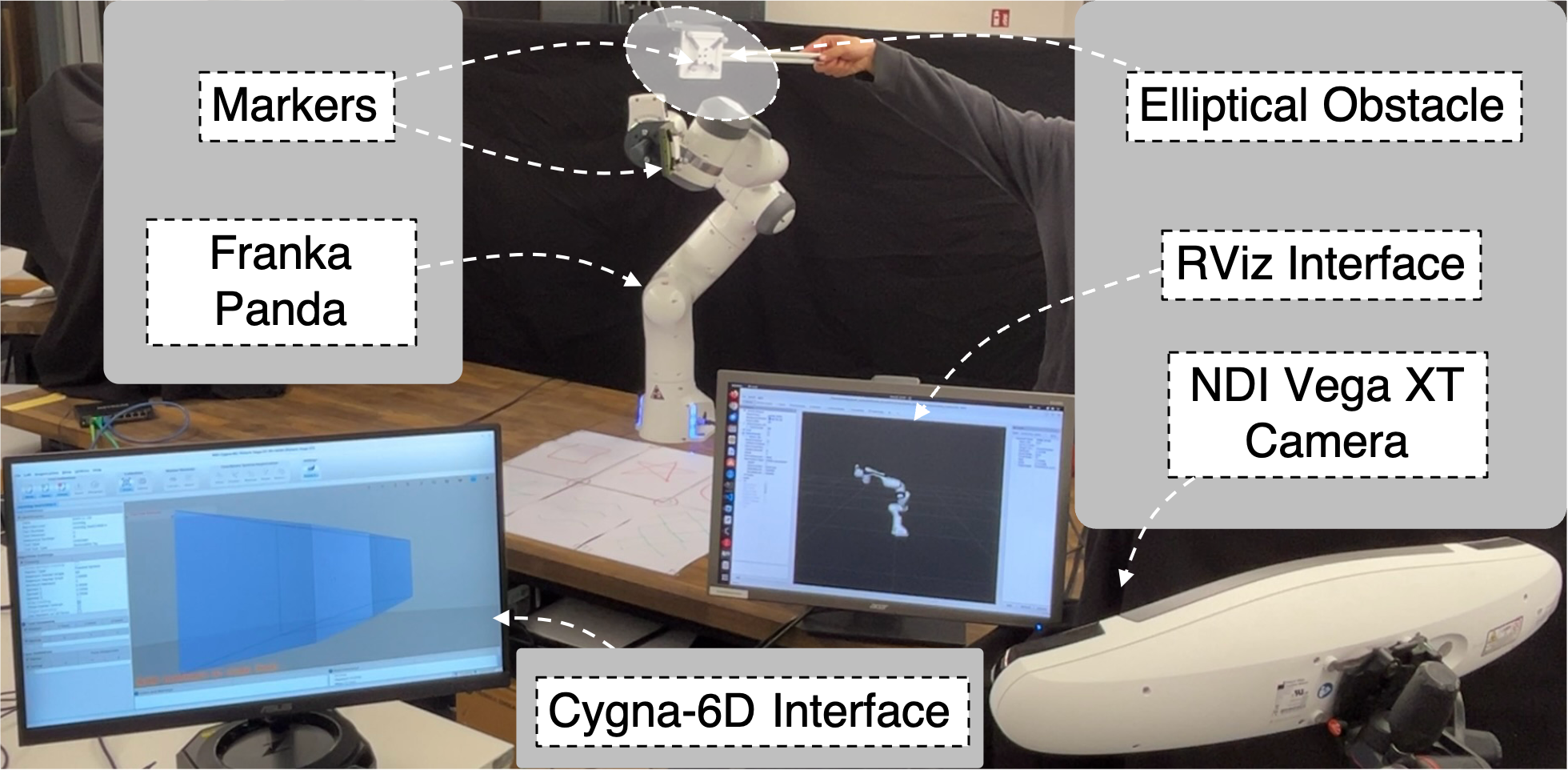
Real Robot Experiment Setup
The experimental setup for the manipulator. The obstacle is modeled as an ellipsoid for collision avoidance purposes, with its geometric center defined by the attached marker. Marker positions are measured via an NDI Polaris Vega XT optical tracker, while the robot state is visualized in RViz.
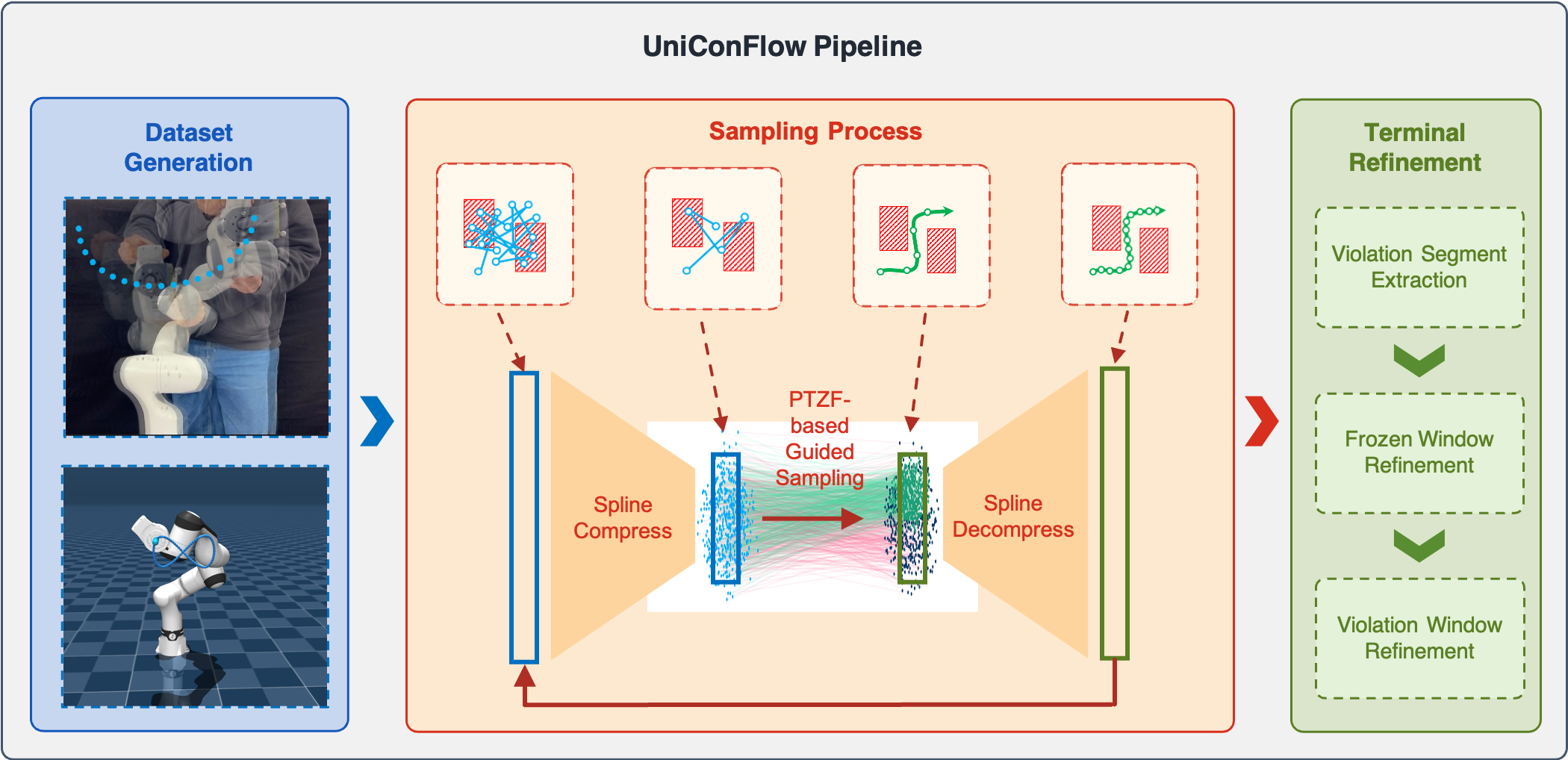
UniConFlow Robot Pipeline
The inference pipeline for the manipulator task.

7-DoF Manipulator in 3D Spatial Motion

For sim-to-real evaluation on the 7-DoF Franka Panda manipulator, we first generate a training dataset in the MuJoCo simulation environment via model predictive control. The generative models are trained on this dataset before deploying the resulting UniConFlow planner directly on the hardware for evaluation.

This task presents significantly greater challenges than the car-racing benchmark. Due to the high control frequency (1000 Hz), the resulting state-action trajectories are both high-dimensional and long-horizon.

UniConFlow achieves 100% success rates across all metrics in both pseudo-2D and full 3D spatial motion scenarios, with costs 5-10 orders of magnitude lower than baselines while maintaining real-time performance (32-105 ms).

  • Sim-to-real experimental scenarios: Pseudo-2D workspace for intuitive visualization and full 3D spatial motion with circular trajectories, both validated on physical hardware.
  • Trajectory compression: B-spline encoder-decoder representation compresses high-dimensional, long-horizon trajectories to a compact latent space, maintaining computational tractability while preserving constraint enforcement in native robot space.
  • Motion capture integration: NDI Polaris Vega XT optical tracker determines obstacle positions relative to the robot, enabling precise collision avoidance in real-world deployment.
  • Consistent superior performance: All baseline methods (vanilla generative models, guidance methods, optimization-based methods) fail catastrophically with high violations, timeouts, or infeasible trajectories, while UniConFlow maintains 100% success rate and zero violations.

Results

Click on a method to view details. Switch between Image and GIF views.

Quantitative Results

Hover over cells to highlight row and column.

Code

Coming soon